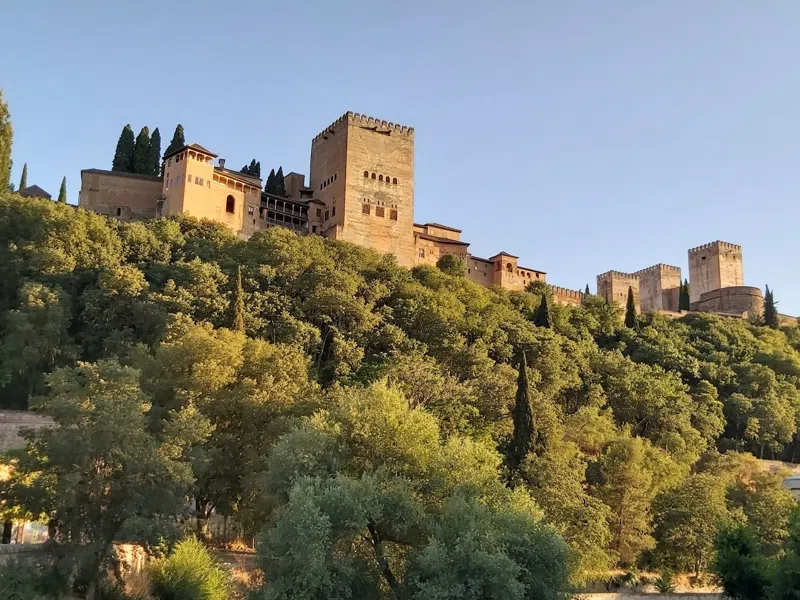
The last fifteen minutes of the climb up Maungawhau are the steepest, and they are also where Auckland stops being a map and becomes a shape. By the time the boardwalk levels out at the rim you have the Waitematā on one side, the Manukau on the other, and a grassed crater some fifty metres deep at your feet, fenced and deliberately empty. November is the maunga at its most generous and its most changeable at once: spring grass still green, light holding past eight in the evening. That combination is worth planning a day around instead of hoping for it.
The hill itself, and why a short walk is not a casual one
Maungawhau / Mount Eden (Mt Eden, roughly three kilometres south of the city centre) is the highest natural point on the Auckland isthmus at about 196 metres, and that modest number does a great deal of work. Because the isthmus is narrow and the cone sits near the middle of it, the tihi, the summit, gives you both harbours in a single turn of the head, the city towers to the north, farmland and ranges to the south, and the flat-topped bulk of Rangitoto out in the gulf. More to the point, you are standing on one volcano looking across a field of around fifty others, several of which are obvious once you know to look: a cone here, a shallow crater there, a hill that turns out to be a tuff ring with houses on it.
The crater you are looking into is Te Ipu a Mataaho, and it is why the summit area looks orderly instead of trampled. The walk up from the base takes fifteen to twenty minutes on sealed path and boardwalk, and a rim loop adds another ten. Allow forty-five minutes to an hour from car door to car door if you only want the view, and ninety if you want to read anything, drink anything, or let a group spread out. There has been no vehicle access above the gate since 2016, so everyone walks the same final stretch: independent walkers, school parties, cruise passengers, the fittest and the least. The gradient is steady rather than brutal, but it is continuous, and in a stiff westerly the last ramp onto the rim is where people stop talking.
Ten minutes of reading that changes what you are looking at
Te Ipu Kōrero o Maungawhau (the visitor experience centre, on the maunga itself) is free, needs no booking, and is the best use of ten minutes on the hill. It is the only place up there that explains why the crater floor is fenced, what the terracing and pits under the grass actually are, and who the mana whenua of this maunga are. Walk it before you climb, not after; the summit reads completely differently once you understand that you are on an archaeological site with a living owner and not a scenic lookout that happens to have old earthworks on it.
The rooms are small. A pair or a family moves through comfortably; a group of more than about a dozen should split and rotate, which is also the practical answer for tour leaders who would prefer to keep everyone together. Ten minutes each in two waves works. Twenty people at once does not.
The rules, stated plainly, because they are easy to get wrong
The crater floor is wāhi tapu and off-limits. That is a prohibition, not a discouragement. The boardwalk around the rim is narrow by design, and large groups are expected to stay single file on it, which sounds fussy until you are on it behind four people walking abreast. If you are leading anyone, brief them at the bottom. The predictable failure is a well-meaning group being asked to come back off the grass at the top, which is avoidable and a poor way to spend your ten minutes at the rim.
The walk starts at Tahaki Reserve (the base park on the Mt Eden side), a free open reserve with the main visitor car parks, a playground and the toilets. Time limits on the parking are enforced, so this is not somewhere to leave a car for half a day. Coaches generally set down on Mt Eden Road instead of parking in the reserve. Families with small children often get exactly what they came for here and never go up at all: the playground, the grass, a view of the cone instead of from it. That is a legitimate plan and not a consolation prize. The Tūpuna Maunga Authority was upgrading lighting in the reserve through 2026; the maunga gates still close at night, so treat the summit as a daylight proposition.
Best time to go in November
November is late spring here, and the pattern that matters is wind more than rain. Mornings are usually the calmer half of the day, and a clear, still 8am on the rim is the version of this walk that people remember. By early afternoon the sea breeze has usually found the cone, and the rim has no trees, no shelter and no building to stand behind. Take a layer you would otherwise think unnecessary, because the temperature at the top and the temperature in the village are not the same number.
For light, the sun sets after eight o'clock by late November, which opens up a good option: climb at six or seven in the evening, when the coach traffic has gone and the city is turning gold, then come down for dinner. For quiet, any weekday morning beats any weekend morning, and weekend mornings in the village are the busiest hours of the week for the cafés, not for the hill. Cruise season is underway in November, so go early or late if you want the rim without groups on it.
Two scheduling traps are worth noting while you plan the day. Eden Garden (Epsom, on the eastern flank of the maunga) is closed Mondays, and its peak flowering falls squarely in the spring-into-November window, which makes it the strongest paid pairing with a free summit walk: $12 adult, $8 for NZ seniors and students, under-12s free, and $8 per person for groups of fifteen or more, with café tables bookable. And the Auckland War Memorial Museum (Auckland Domain) opens late on Tuesdays to 8.30pm, the one evening you can do the maunga and the museum in the same day without rushing either.
Coaches, queues and whether to pay for a guided version
There is no ticket for Maungawhau, no gate fee and no booking system, so there is no entry queue to avoid. The practical queues are elsewhere: the car park at Tahaki when three families arrive at once, and the single counter at the kiosk when a full coach lands. That free, unticketed status is also why groups walk straight on without any co-ordination at all, and why the rim can go from empty to twenty-deep in the time a bus takes to unload on Mt Eden Road.
Guided options do exist, usually as half- or full-day volcano-and-viewpoint circuits that fold the maunga in with other cones and a harbour or two, and several are built around cruise-ship timings with port pickup. Across the bookable tours here there are 199 traveller reviews, and the top-rated tour holds 4.3 out of 5 from 52 reviews, a decent record and not a stampede. Prices start from 329 USD per person for the private end of the range, and that is the number to weigh: you are paying for transport, timing and a guide's commentary, not for access. If you have a car, a transit card or two working legs and half a day, you do not need a tour to do Mt Eden. If you are off a ship with six hours, no vehicle and a list of three cones, a guided circuit is the only way the arithmetic works. Book ahead instead of trying to arrange something on the morning, particularly on cruise days.
The fair paid comparison in the city is the Sky Tower (city centre), at NZ$47 for an adult ticket to all three observation levels, with timed entry that absorbs coach and cruise traffic all day; through October and November it runs Monday to Thursday 9.30am to 8pm with last entry at 7.15pm, and longer Friday to Sunday. The tower goes much higher and stays open later, and on a wet night it is the better call. What it does not do is explain the ground it stands on. Maungawhau puts the volcanic field in front of you from inside it, standing on a cone, looking into a crater, at a cost of nothing.
Coffee on the hill and breakfast before it
Friend & Whau (the kiosk on the maunga) is the only food or coffee on the mountain itself, the current operator in the same space as the earlier café there. Counter service, coffee around $5-6, snacks and light kai about $8-18. It handles tour groups between coaches, but it is one small counter, so a full bus arriving at once means a wait. If you are leading a group and want everyone caffeinated at the same time, do it before you arrive.
For that, Olaf's Artisan Bakery Café (Mt Eden) is the right stop: a small seven-day bakery with pastries around $6-9, loaves $9-14 and coffee $5-6, sitting between Maungawhau station and the maunga, which makes it the natural interception point if you come in by train. It is counter service in a tight room, fine for grabbing breakfast in hand for eight people and hopeless for seating them.
Where to put a group, and where to put a couple
Frasers Mt Eden (Mt Eden village) is the most reliable sit-down option for a group that wants one table and one bill. It has been running since 1998, opens at 6.30am and goes through to late daily, and it explicitly takes large tables and long lunches with notice, which also means it can feed you before a sunrise climb, something almost nothing else in the village can do. Brunch runs about $22-30, dinner mains $32-45, and there is a daily 3-6pm window with small plates at $15 and drinks from $9.
Circus Circus (Mt Eden village) is the better-known brunch room and a real neighbourhood institution, at similar money: brunch $22-30, dinner mains $34-45. The trade-off is simple. It is often full at weekends, weekends are brunch menu only, and a walk-in group on a Sunday will wait. Book, or go on a weekday.
For dinner with more character, Cazador (Mt Eden, on the Dominion Road side) is the most distinctive eating in the wider area and genuinely of this place, with wild venison, hare and goat from local hunters. The deli opens daily from 8am with pies around $9-12, and the restaurant runs Wednesday to Saturday from 5pm with mains $38-48. The dining room is small; book well ahead, and give real notice for a group. Galbraith's Alehouse (Grafton) is the other natural end point, especially if you walk down the Mt Eden Road side. It has brewed cask-conditioned real ale on site since 1995, opens from noon daily with the kitchen running to 9pm, charges no public-holiday surcharge, and does a Sunday roast at $29.90 adult, $19.90 child. Pints are $12-14 and pub mains $28-36. Groups over ten go by email to the venue; smaller tables book online. It is a flat two kilometres from the cone instead of in the village, a pleasant walk and a less pleasant one in rain.
Quiet rooms, and what to do when the rim is in cloud
Some November afternoons the cone simply disappears into low cloud, and there is no view to be had at any price. Domain Wintergardens (Auckland Domain) is the best free fallback: heritage glasshouses reopened after two years of seismic strengthening, open daily 9am-5pm from 1 November to 31 March. Groups can walk in, but the houses are narrow, so move in small clusters. The Auckland War Memorial Museum is the paid version of the same instinct, with a caveat that matters: the Māori Court, Te Marae Ātea and the Pacific galleries have been closed since 2025 for asbestos remediation. Admission is discounted to reflect that, at around NZ$27 international adult and NZ$13.50 child against the standard NZ$32/$16, under-5s free, and free for Auckland residents with proof of address. The cultural performance (ticketed separately) and the natural-history floor still run, and the volcanic material there pairs well with what you have just climbed.
In the village itself, Chapter Book & Tea Shop (Mt Eden village) has carried around 300 teas since 1995 and is the quietest antidote to a windy summit, with a pot at $6-9, Tuesday to Sunday 10am-4pm. It is tiny, a pair or a family, not a tour group. Time Out Bookstore (Mt Eden village) has traded since 1988 and stays open 9am to 9pm seven days, which makes it the one thing in the village still going after the maunga gates close; it is also where to buy a local history or a te ao Māori title that explains what you have just walked over. Small shop, so browse in twos and threes.
The second cone, if you have the legs
If one volcano has you wanting another, Maungakiekie / One Tree Hill and Cornwall Park (Epsom) is the obvious pairing and arguably the better walk since a new direct summit track from the park opened in May 2026. It is free with free parking, there is no vehicle access to the summit either, and it has what Maungawhau does not: working farmland with sheep and cattle, three eateries, and the Huia Lodge Discovery Hub, open 10am-4pm. Mobility access codes are available on 09 379 1340, and picnic groups over thirty need an event enquiry. Two cones in a morning is a realistic plan; add either one to the Auckland guide for how they fit a wider few days.
Is it worth it
Yes, with one qualification: go up with ten minutes of context rather than none, and it stops being a lookout and becomes the clearest single lesson in why this city is shaped the way it is. It costs nothing, takes under an hour, and gives you a better understanding of Auckland than any paid vantage point in it. It suits walkers, families with children over about five, photographers at either end of the day, and anyone with a few hours off a ship. It suits less well those who cannot manage twenty minutes of continuous uphill, since there is no vehicle option above the gate, and those who want a view with a bar attached: there is a kiosk, not a terrace. On a flat grey day with the rim in cloud, skip it and come back; it is free, so there is no sunk cost in waiting for the weather.
Practical notes
The train to Maungawhau station puts you a walk from the base past Olaf's; buses run Mt Eden Road; a taxi or rideshare from the city centre is ten to fifteen minutes outside peak. If you drive, use the Tahaki Reserve car parks and respect the time limits, and remember that you cannot drive any higher than the gate.
The maunga, the visitor centre, Tahaki Reserve, the Wintergardens and Cornwall Park are all free. Cards are taken everywhere that matters; carry a little cash out of habit rather than necessity. A no-cost day is entirely possible: climb, visit the centre, walk the village. A comfortable paid day runs roughly NZ$60-90 a head for garden entry, a sit-down brunch and a pint afterwards, and the Sky Tower adds NZ$47 if you want the altitude comparison.
Climb early or in the last two hours of light; avoid midday on a cruise day; book weekend brunch and any dinner for more than four; check that it is not a Monday if the garden is part of your plan, and consider Tuesday if you want the museum's late evening.
Mt Eden and the blocks between the village and the city centre hold a good number of serviced apartments and villa-style stays, a quieter base than the waterfront and still fifteen minutes from it; compare rates and locations on Auckland hotel search. Wherever you sleep, set an alarm once for a still morning on the rim. It is the cheapest hour you will spend here.